Effective Treatments for Panic Attacks: The Complete Recovery Guide

If you have ever felt your heart race out of nowhere, your chest tighten, and a wave of absolute terror consume you, you know how debilitating a panic attack can be. You are far from alone in this experience; clinical data show that panic attacks affect 1–4% of the global population during their lifetimes. The most important thing to understand right now is that you do not have to live at the mercy of these episodes. By exploring effective treatments for panic attacks, you can learn to disarm the fear response, rewire your brain's alarm system, and safely reclaim control over your daily life.
Modern psychology and medicine have made massive strides in understanding how panic operates in the human body. What once felt like an unpredictable, terrifying medical mystery can now be systematically dismantled using proven therapeutic frameworks and targeted medical support. Whether you are searching for answers for yourself or trying to support a loved one, this evidence-based guide will walk you through exactly what works, why it works, and how to start your journey toward lasting relief.
What Is a Panic Attack? Unmasking the Physical Reality
Before diving into solutions, we must demystify what is actually happening during an episode. A panic attack is a sudden, intense surge of fear or overwhelming discomfort that peaks within 10 minutes. Because the physical sensations are so profound, many individuals mistake their very first panic attack for a medical emergency, such as a heart attack or a neurological event.
During an acute episode, your body is experiencing a massive, instantaneous release of adrenaline. This chemical cascade triggers a wide range of physical and psychological symptoms. Clinically, a panic attack is identified by the sudden onset of at least four of the following symptoms:
- Cardiovascular Surges: A racing, pounding, or skipping heartbeat accompanied by chest pain or localized discomfort.
- Respiratory Distress: Shortness of breath, hyperventilation, or a choking feeling as if you are being smothered.
- Neurological Shifts: Dizziness, lightheadedness, unsteady balance, or a feeling that you might faint.
- Sensory Changes: Numbness, tingling sensations (paresthesia) in your hands or feet, alongside sudden chills or hot flashes.
- Gastrointestinal Distress: Sudden nausea, stomach cramps, or a churning feeling in your gut.
- Psychological Terror: An intense fear of losing complete control, "going crazy," or an impending sense of mortality.
- Perceptual Distortion: A feeling of detachment from your physical body (depersonalization) or a sense that your surroundings aren't real (derealization).
Understanding these panic disorder symptoms as physical markers of an overactive safety system—rather than a sign of internal damage—is the foundational step in all anxiety reduction techniques.
The Brain's Misfired Alarm: The Fight-or-Flight Response
To understand why effective treatments for panic attacks work, we have to look at the survival architecture of the human brain. Deep within your temporal lobes sits a small, almond-shaped structure called the amygdala. This is your body's smoke detector. Its sole responsibility is to scan your environment for danger and keep you alive.
When a primitive human encountered a predator, the amygdala instantly fired, activating the sympathetic nervous system. This system floods the bloodstream with adrenaline and cortisol, rerouting blood away from your digestive system and into your large muscle groups. Your heart pumps faster to oxygenate your muscles, and your breathing quickens to take in more oxygen. This is the classic fight-or-flight response.
In an individual experiencing panic attacks, this alarm system has become hypersensitive. The amygdala fires without an external threat. It detects a minor internal shift—perhaps a slight increase in heart rate from caffeine or a brief moment of stress—and misinterprets it as a mortal danger. Your body launches a full survival response while you are simply sitting at your desk or driving home. It is incredibly uncomfortable, but it is vital to remember: your brain isn't broken; it is simply trying too hard to protect you.
First-Line Psychotherapy: The Power of Cognitive Behavioral Therapy
When it comes to long-term recovery, clinical consensus consistently points to Cognitive Behavioral Therapy (CBT) as the gold standard of care. Unlike general talk therapies that look extensively into your past, CBT is an active, present-focused treatment. It typically spans over a course of 8–20 weekly sessions, providing you with concrete structural skills to retrain your overactive nervous system.
The Core Pillars of CBT for Panic
- Comprehensive Psychoeducation: You will work with a therapist to break down the anatomical mechanics of anxiety. Learning the physiological "why" behind your symptoms robs the panic attack of its mystery and power.
- Active Cognitive Restructuring: Panic thrives on catastrophic thinking errors. When your heart rate rises, your brain might tell you, "I am dying." CBT teaches you to identify these thoughts, challenge their validity, and replace them with objective, neutral realities, such as, "My heart is pumping fast because of adrenaline, and it will pass safely."
- Structured Interoceptive Exposure: This is the most transformative element of panic therapy. Under professional guidance, you will intentionally induce mild, harmless physical sensations that mimic panic—such as spinning in a chair to cause dizziness or breathing through a straw to mimic shortness of breath. By facing these sensations in a safe space without fleeing, your brain learns that the physical symptoms themselves are completely safe.
- Gradual In Vivo Exposure: Many individuals with panic begin practicing agoraphobia avoidance, skipping places where an attack might occur (like grocery stores or public transit). In vivo exposure involves creating a step-by-step ladder to gradually re-enter these spaces, breaking the cycle of avoidance.
For individuals who face geographic or financial barriers to traditional mental health care, Zizmor Mental Health offers an alternative. Specialized, internet-based CBT programs have been rigorously studied and proven to deliver outcomes comparable to traditional, in-person therapy.
The Medication Matrix: Understanding Pharmacological Options
While therapy rewires your behavioral responses, pharmaceutical interventions can provide crucial biological support. Medications are often used to lower the baseline "volume" of your anxiety, making it easier to engage effectively in daily life and therapeutic exercises.
When discussing options with your doctor, treatments generally fall into three distinct categories:
| Medication Class | Common Examples | Onset Time | Primary Clinical Role |
| SSRIs (Selective Serotonin Reuptake Inhibitors) | Sertraline, Escitalopram, Fluoxetine | 2–4 Weeks | First-line, long-term daily preventative care. |
| SNRIs (Serotonin-Norepinephrine Reuptake Inhibitors) | Venlafaxine, Duloxetine | 2–4 Weeks | Alternative first-line preventative for daily stability. |
| Benzodiazepines (Targeted Anxiolytics) | Clonazepam, Alprazolam | 15–30 Minutes | Short-term emergency use only; halts acute panic rapidly. |
The Role of Daily Preventatives (SSRIs and SNRIs)
SSRIs and SNRIs are considered first-line pharmacological options. They are not designed to stop an attack in progress; instead, they are taken daily to gradually adjust your brain's serotonin and norepinephrine levels. Over a few weeks, they raise your panic threshold, making your amygdala less reactive to triggers. Clinical guidelines recommend maintaining these medications for at least one year following symptom resolution to ensure deep neurological stabilization.
The Cautionary Use of Benzodiazepines
Benzodiazepines act as rapid nervous system sedatives. While they are highly effective at halting an acute attack within minutes, they are generally not recommended as a long-term strategy. Because the body can quickly develop a tolerance and dependence on these substances, they are best utilized as a temporary bridge while waiting for your primary daily medication or your CBT skills to take full effect.
The Real-Time Rescue Blueprint: Self-Management Strategies
Professional care builds your long-term resilience, but you also need practical tools you can deploy the very second you feel a wave of anxiety rising. Bookmark these strategies and practice them when you are calm so they become second nature during high-stress moments.
What to Do Mid-Attack
- Acknowledge and Anchor: Do not try to fight, suppress, or deny the panic. Fighting releases more adrenaline, which extends the attack. Instead, drop your shoulders and state internally: "I am experiencing a wave of panic right now. It is highly uncomfortable, but I am medically safe, and it will peak and fade within minutes."
- Deploy Box Breathing: Hyperventilation changes the carbon dioxide balance in your blood, causing dizziness and tingling. Correct this by inhaling deeply through your nose for 4 seconds, holding your breath for 4 seconds, exhaling completely through your mouth for 4 seconds, and holding empty for 4 seconds. Repeat this loop five times.
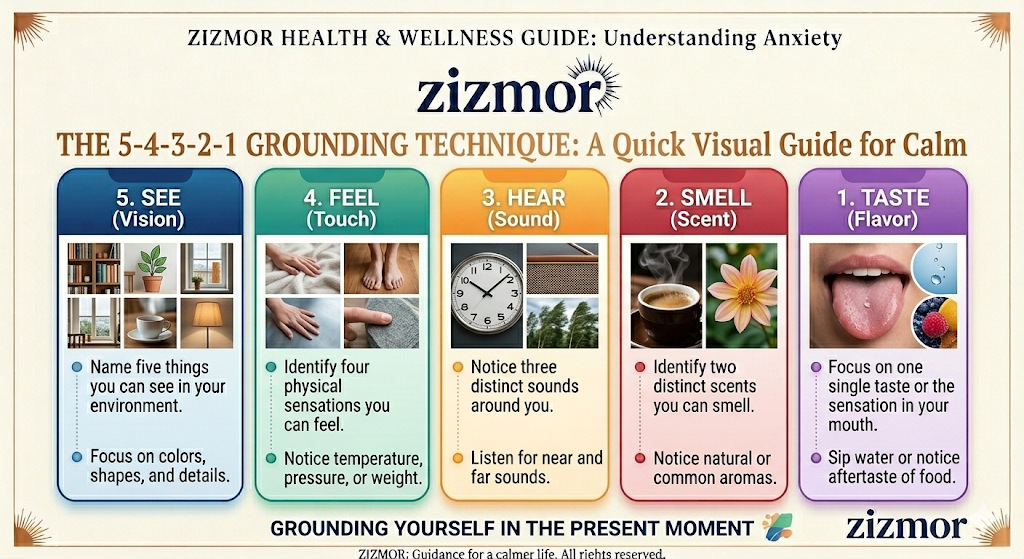
- Execute the 5-4-3-2-1 Grounding Method: Panic pulls your awareness entirely into the terrifying loops of your mind. Grounding forces your brain back into the physical safety of your current environment. Look around you and consciously name:
- 5 things you can see (e.g., a clock, a coffee cup, a floor tile pattern).
- 4 things you can physically touch (e.g., the texture of your jeans, the cold surface of a desk).
- 3 distinct things you can hear (e.g., traffic outside, an air conditioner hum, birds chirping).
- 2 things you can smell (e.g., hand lotion, old book pages).
- 1 thing you can taste (e.g., the lingering flavor of mint or toothpaste).
Building Long-Term Resilience Between Attacks
True freedom from panic requires lifestyle choices that lower your baseline autonomic arousal. Think of your body like a biological budget; if you consume items that mimic stress, your threshold for panic decreases significantly.
- Strategic Caffeine and Alcohol Elimination: Caffeine ($C_8H_{10}N_4O_2$) is a direct central nervous system stimulant that elevates your heart rate and mimics the early physical markers of panic. If you are prone to episodes, taper off caffeine entirely. Similarly, while alcohol may feel calming initially, its withdrawal phase drastically destabilizes your nervous system, often triggering severe morning-after panic.
- Consistent Cardiovascular Movement: Engaging in 30 minutes of moderate aerobic exercise—such as brisk walking, cycling, or swimming—three times a week helps burn off accumulated stress hormones. Regular movement also teaches your brain to associate a racing heart with health and vitality rather than mortal danger.
- Protect Your Sleep Architecture: A sleep-deprived brain is a reactive brain. When you miss out on deep restorative rest, your prefrontal cortex loses its ability to effectively regulate and quiet the amygdala.
The Recovery Timeline: What to Expect
Healing from panic disorder is a journey, and understanding the typical timeline can keep you anchored when facing challenges along the way. Most individuals who engage in a structured treatment plan begin to notice a substantial reduction in both the frequency and intensity of their attacks within 2 to 6 months.
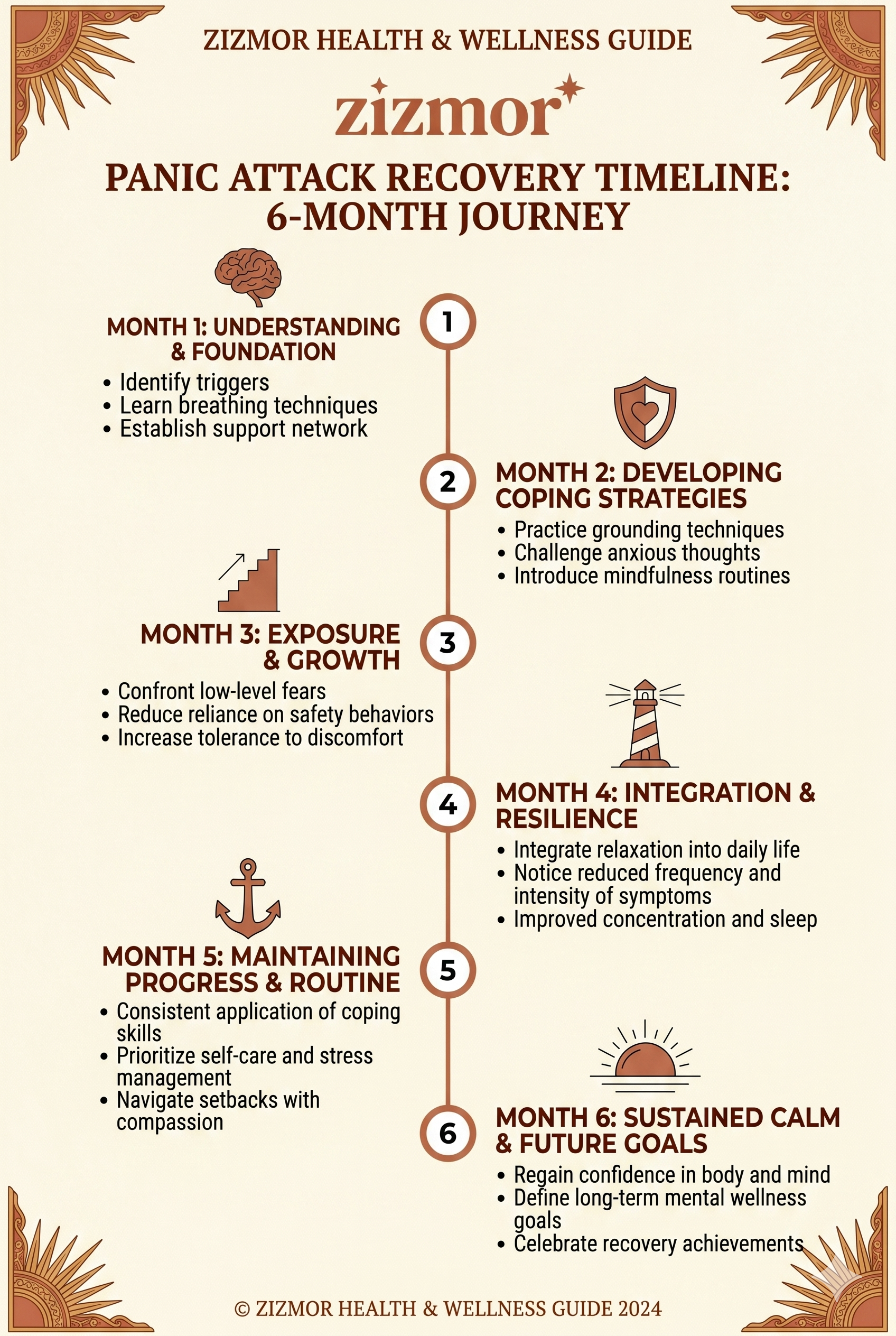
It is vital to know that recovery is rarely linear. You may go three weeks without an episode and then suddenly experience a sharp panic attack on a random Tuesday. This is a completely normal part of neurological retraining; it does not mean your treatment is failing or that you are back at square one. A single episode is simply an old neural pathway firing one last time as your brain builds new, resilient tracks. Over time, the space between attacks will widen, and the intensity will fade until the episodes disappear entirely.
When to Connect with a Specialist
While self-help strategies are incredibly valuable, certain indicators signal that it is time to seek targeted, professional care. Consider reaching out to an adult mental health professional or primary care provider if:
- Your panic attacks are actively causing you to alter your daily routes, miss work, or avoid social connections.
- You find yourself constantly worrying about when the next attack will strike, a pattern known as "fear of fear."
- You are attempting to manage your symptoms by relying on alcohol, recreational substances, or unhealthy lifestyle restrictions.
- Your anxiety is beginning to co-occur with persistent feelings of hopelessness, deep sadness, or Signs of Clinical Depression.
Freedom is Within Reach
Panic attacks are undeniably one of the most terrifying physical experiences a human being can endure, but they are entirely manageable. They are not a reflection of personal weakness, a lack of willpower, or a hidden medical defect. They are simply a temporary misfire of a survival mechanism that you can learn to master.
By stepping forward with evidence-based frameworks—whether through the cognitive restructuring of CBT, strategic medical choices, or targeted lifestyle interventions—you are taking active control of your health. Be patient with your nervous system, practice your grounding skills when you are calm, and remember that help is always available. The path back to a life of freedom, confidence, and peace is entirely possible.